
Introduction
The cooperative relationship between humans and dogs represents one of the earliest and most well-documented examples of interspecies collaboration. Archaeological, genetic, and isotopic evidence indicates that this relationship began during the Late Pleistocene, prior to the development of agriculture. The earliest evidence suggests that wolves and humans formed a mutualistic association that later resulted in the domesticated dog (Canis familiaris).
Archaeological Evidence of Early Human–Dog Associations
Bonn-Oberkassel Burial (Germany, ~14,200 years ago)
One of the clearest early examples of humans and dogs living in close association comes from the Bonn-Oberkassel site in Germany. Excavations revealed a joint burial of two humans and a dog dated to approximately 14,200 years before present.
Analysis of the dog’s remains showed signs of prolonged illness, likely canine distemper, which would have required sustained care to survive. This indicates that humans were providing food and protection to the animal over an extended period, demonstrating cooperative interaction beyond simple tolerance or scavenging.
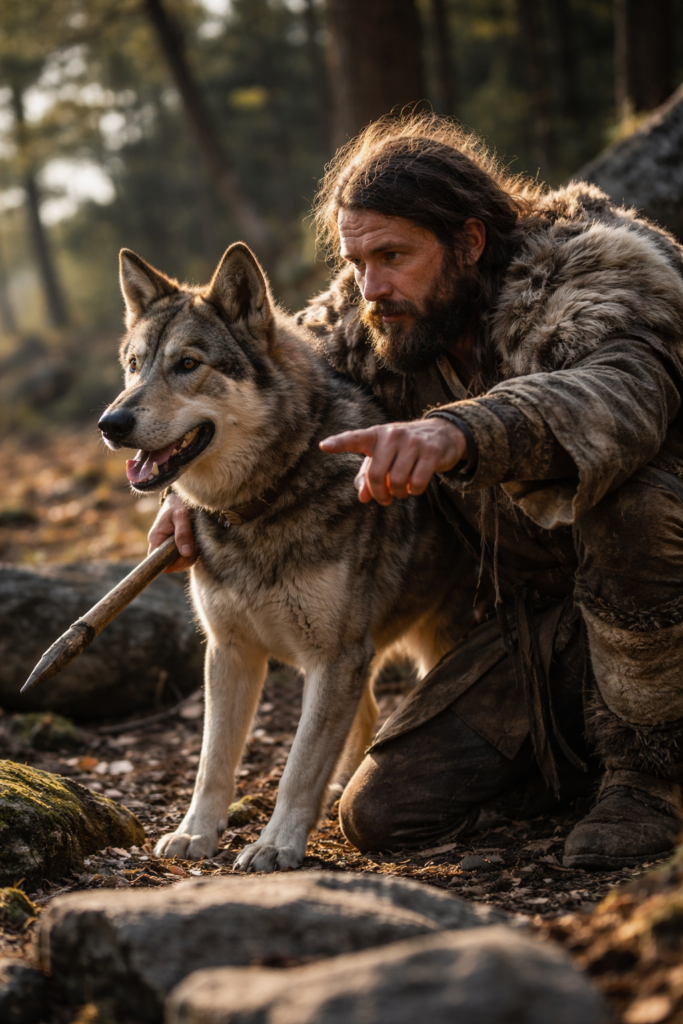
Key evidence:
Intentional burial with humans
Long-term survival despite debilitating illness
Temporal association with Late Upper Paleolithic humans
Earlier Canid Remains with Human Association
Goyet Cave (Belgium, ~36,000 years ago)
Canid remains found at Goyet Cave display morphological differences from both modern wolves and later domestic dogs. Some researchers classify these remains as early proto-dogs. While direct evidence of cooperation is limited, the remains suggest early divergence from wolf populations living in proximity to humans.
Predmostí Site (Czech Republic, ~28,000 years ago)
Large canid skulls discovered at Predmostí exhibit shortened snouts and dental crowding, traits often associated with domestication. Some skulls were found in contexts suggesting symbolic or ritual treatment, including one with a mammoth bone placed in the mouth.
These findings suggest close human–canid relationships, though functional cooperation such as hunting assistance cannot be definitively confirmed at this stage.
Genetic Evidence for Early Domestication
Genomic studies indicate that dogs diverged from wolves at least 20,000–40,000 years ago, with some estimates extending earlier. Genetic separation occurred well before the advent of farming, indicating that domestication began among hunter-gatherer societies.
Population genetics also show that dogs adapted to human-associated environments earlier than livestock species, supporting a long-standing cooperative relationship.
Evidence for Functional Cooperation
Hunting and Scavenging
Ethnographic analogy and archaeological inference suggest early dogs may have assisted humans by:
Tracking prey
Alerting to danger
Aiding in locating wounded animals
Scavenging waste, reducing environmental attractants for other predators
Stable isotope analysis from early dog remains shows diets similar to those of humans at the same sites, indicating food sharing and parallel subsistence strategies.
Pathways to Cooperation
The prevailing model for early cooperation is the commensal scavenger hypothesis, in which less aggressive wolves exploited human refuse sites. Over time, selection favored canids that tolerated human proximity. Humans, in turn, benefited from the wolves’ sensory abilities and deterrence of other predators, leading to increased interaction and eventual domestication.
This model is supported by:
Archaeological site overlap
Gradual morphological changes
Genetic adaptations related to social behavior
Conclusion
The earliest evidence of humans and dogs working cooperatively dates back at least 14,000 years, with earlier proto-dog associations potentially extending beyond 30,000 years ago. Archaeological burials, morphological changes, genetic divergence, and isotopic data collectively support the conclusion that dogs were the first domesticated animals and that their domestication emerged from sustained cooperative interactions with hunter-gatherer societies.